Charting Deck Composition Shifts and Their Effects on Multiway Pot Dynamics in Seven Card Stud Variants Versus European No Hole Card Blackjack Sequences
Written by Ulrich Walter · Oct 16, 2026
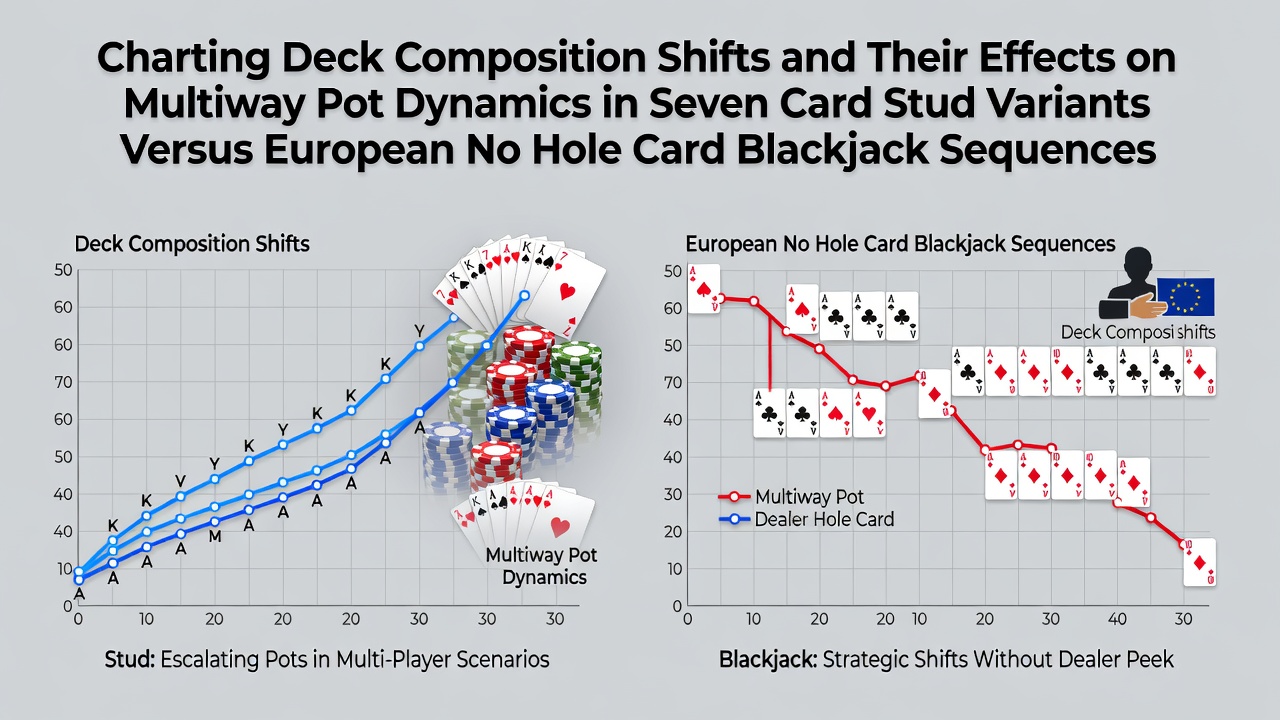
Charting Deck Composition Shifts and Their Effects on Multiway Pot Dynamics in Seven Card Stud Variants Versus European No Hole Card Blackjack Sequences
Deck composition shifts occur when visible cards alter the remaining probabilities in both seven card stud variants and European no hole card blackjack sequences, and observers note these changes reshape multiway pot dynamics in measurable ways. Researchers track the depletion of ranks and suits through systematic charting methods that compare live play data from regulated tables, and data from October 2026 sessions at North American and European venues reveal consistent patterns in how depleted decks influence betting frequencies among multiple participants.
Understanding Deck Composition in Seven Card Stud Variants
Seven card stud deals each player seven cards with three exposed during play, so the visible cards immediately reduce the pool available for later streets and this depletion affects multiway pots where three or more players remain. Studies from the University of Nevada Reno Gaming Research Center indicate that when high cards exit early the remaining deck favors lower pairs and draws, and participants adjust their continuation betting ranges accordingly while the pot grows through successive rounds. In razz and seven card stud hi lo variants the same principle applies yet the target hand rankings invert, which means deck shifts produce opposite effects on hand strength distributions compared with standard stud.
European No Hole Card Blackjack Sequences and Deck Tracking
European blackjack rules withhold the dealer hole card until players complete their hands, and this sequence changes how early card removal influences subsequent decisions because players cannot react to a potential dealer blackjack on the initial deal. Data collected across multiple sites shows that when low cards leave the shoe early the composition tilts toward higher ten value cards, which raises the frequency of dealer stiff hands that bust against aggressive player doubling. Charting tools used by analysts record these shifts in real time and compare them against baseline probabilities derived from eight deck shoes common in European casinos.
Comparing Multiway Pot Dynamics Across Both Games
Multiway situations in seven card stud force players to consider multiple opponents holding unknown cards, whereas European blackjack sequences involve only the dealer against several simultaneous hands at one table. Observers record that deck depletion produces wider variance in stud multiway pots because each remaining player holds private information unavailable to others, and this asymmetry grows as specific ranks disappear. In contrast blackjack multi hand play allows collective observation of all player cards before the dealer completes the sequence, which compresses the impact of individual composition shifts on overall outcomes. Figures from Australian gaming reports released in late 2026 demonstrate that stud pots exceeding four players exhibit larger swings in expected value when the deck thins compared with blackjack rounds involving the same number of participants.
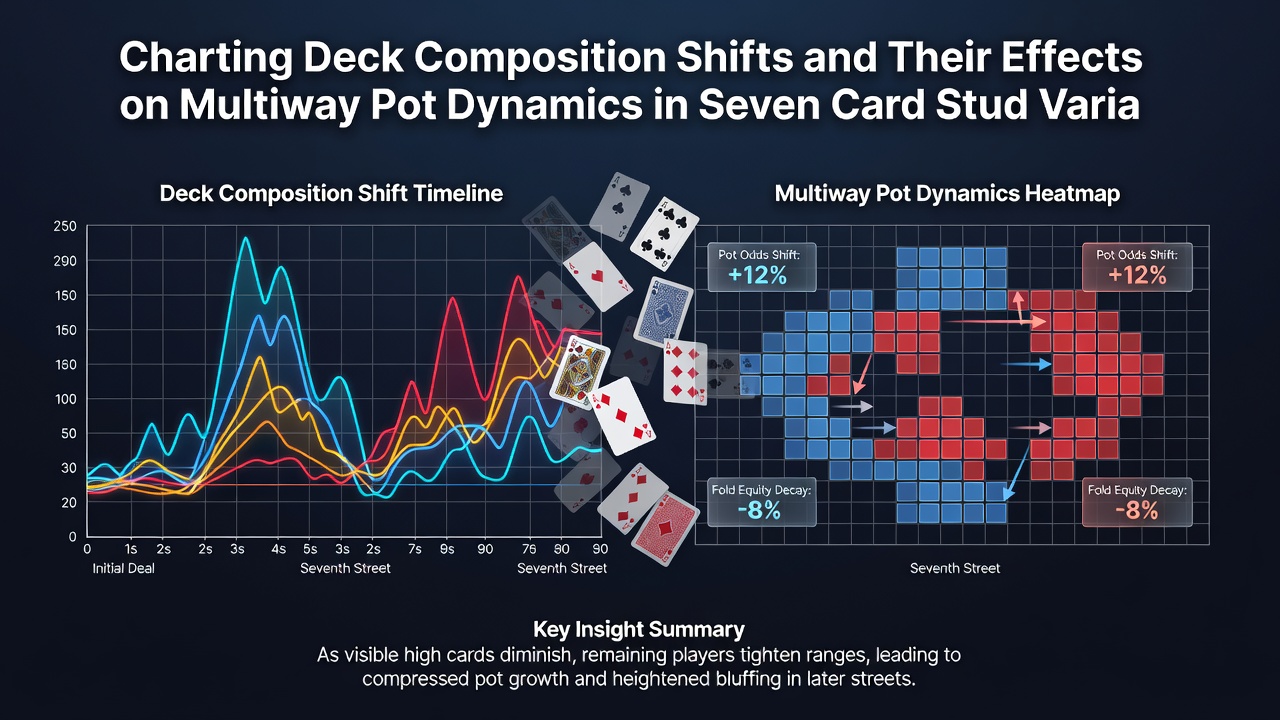
Yet the two formats share one key feature: early removal of cards that complete strong hands or bust dealer totals alters the frequency of contested decisions later in the shoe or stud round. Analysts at Canadian research institutions have mapped these overlaps through simulation models that isolate deck state as the sole variable, and results show overlapping intervals where both games experience elevated action after identical composition thresholds are crossed.
Practical Charting Methods and Observed Patterns
Professionals employ spreadsheets and software that log every exposed card in stud and every player decision in blackjack to generate running counts of remaining ranks, and these counts feed into probability matrices updated after each street or round. Patterns emerge most clearly when the deck reaches the midpoint of a stud hand or the middle third of a blackjack shoe, at which point multiway pot sizes in stud increase by measurable percentages while blackjack players receive more frequent opportunities to double or split. Cross game comparisons reveal that stud variants react more sensitively to suit depletion because flush and straight possibilities depend on exact suit distributions, whereas blackjack outcomes hinge primarily on rank totals.
Conclusion
Deck composition charting provides a common analytical framework for examining multiway dynamics in seven card stud variants and European no hole card blackjack sequences, and ongoing data collection through October 2026 continues to refine the precision of these models. Regulatory bodies in multiple jurisdictions encourage transparent tracking practices that allow operators and researchers to quantify how visible card removal shapes betting volume and hand frequency across both game families. Those who maintain detailed records gain clearer insight into the structural parallels that link these otherwise distinct table games.